
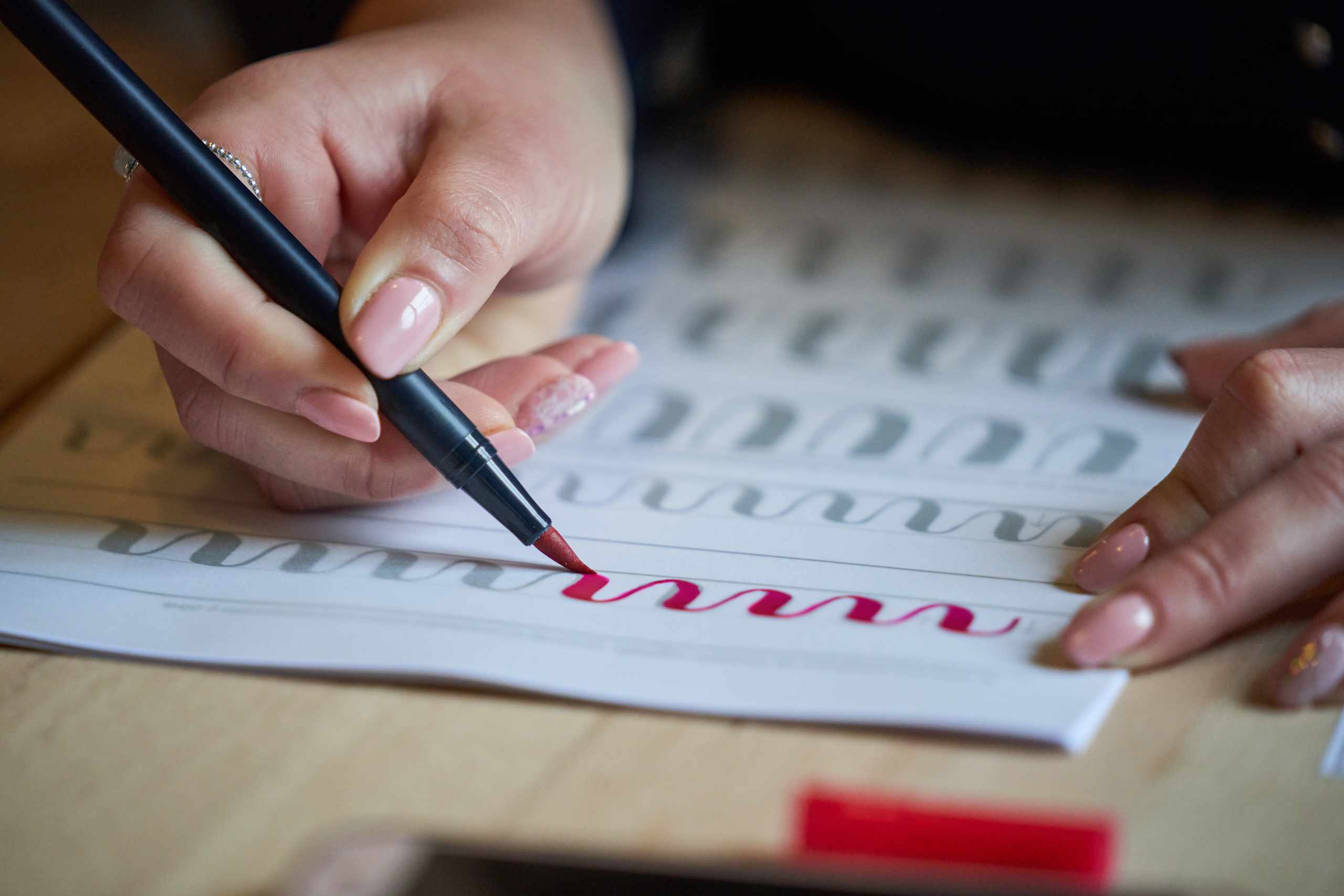
Your letters may actually look really good by themselves, and suddenly in a word, they all fall apart. This is frustrating for most beginners, but it also often remains a mystery initially. A letter can feel fine on its own. But when you write “an”, that “a” feels fine, that “n” feels fine, but the word “an” feels awkward and unsteady and stiff. That’s because letterform isn’t just letterform. It’s also rhythm and movement between letters and word and space. To avoid pieced-together calligraphy, work on words right from the start.
The first thing to know is that letters behave differently when joined together. A tidy isolated “m” looks too big after an “i”. A perfect “l” may have an overly tight loop next to the following letter. For a long time, beginners work on one letter at a time and then expect the alphabet and words to magically appear. Practice in groups instead. Write a few “mi”s and “no”s and “le”s and “ta”s and feel where the previous stroke ends and the next begins and look at those joined connections as well as the shapes. This is a way of teaching flow, which is a different thing than teaching each shape in isolation.
Spacing is the most common hidden issue. Many beginners focus on the shapes of the letters instead of the shapes of the spaces. In calligraphy, the empty space is just as important as the letterforms. If the spacing is uneven, a word will look off balance even if the letters themselves are correct. Try writing the word, then cover most of the letters with a piece of paper or walk back a bit. You’ll realize that what you think is an “a” issue might be a spacing issue. Many beginners try to fix the space problem by making the next letter smaller. That creates tension and cramping and doesn’t solve the problem. Try writing the word at a slower speed, keeping a more consistent movement.
Another issue with words is uneven pressure, especially when rushing to complete the connections. Downstrokes might look strong and light upstrokes get scratchy when pressing too hard on a downstroke. When that happens, go back to small, repetitive groups. If a transition from an “o” to an “n” looks sloppy, spend some time on words that contain that specific movement: on, no, ono, non. Do this on a big scale to really be able to notice the movement. This focused attention on a specific movement is the most effective approach rather than copying words and sentences that don’t help you address the problem.
A good practice routine might look like this: take 15 minutes and use 5 for general movements, ovals, underturns, entrances, and exits. Then use 5 minutes for the letter combinations used in the word you’re working on. Spend the final 5 minutes on that word. On the first line, work on the slant only. On the second line, focus on the space only. On the third line, try to keep the pressure the same. You won’t feel overwhelmed by too much to focus on and you’ll learn exactly what you’re doing in the moment. If it still doesn’t work, don’t consider it all failure. If something improved, note that, and take it with you into the next group.
Words are a lot more fun when you get that feeling that they’re all flowing from one to the other, rather than the feeling that you just strung together a lot of letters. And that happens with time, but not necessarily a lot of practice time, just by being careful about the rhythm, the spacing, and working the joins over and over and over until the hand knows the connection. Then even simple words come to life, and the pages start to look less like a chore and more like a calligraphy conversation.